Crisp Point was one of five Lake Superior U.S. Life-Saving Service Stations along the coast between Munising and Whitefish Point. It is located about 14.5 miles west of Whitefish Point. It was built in 1875 and became operational in 1876 as Life-Saving Station Number Ten, of the U.S. Life-Saving Service District 10 (it was later part of District 11) . Crisp Point inherited its name from one of the Life-Saving Station keepers, an iron-willed boatman named Christopher Crisp. The other four Life-Saving Stations were Vermillion Point (now Vermilion, which is about 5 miles east of Crisp Point and became operational in 1876), Two Heart River (built 1876), Deer Park (became operational in 1876, formerly Sucker River Station and Muskallonge Lake Station) and Grand Marais (built in 1899 and became operational in 1900).
Crisp Point Lighthouse was first proposed in 1896 and every year thereafter until finally approved in June of 1902. The land was purchased--fifteen acres--at a price of $30.00. The deed was dated May 21, 1903. Originally crowned with a red fixed 360 degree Fourth Order light, the lighthouse tower stands 58 feet from its base to the ventilator ball of the lantern. The tower sits on a concrete foundation 10 feet deep. The Fourth Order Fresnel lens was made by Sautter & Lemonnier of Paris, France. When it was operational, the light produced a focal plane 58 feet above the mean low water level of the lake.
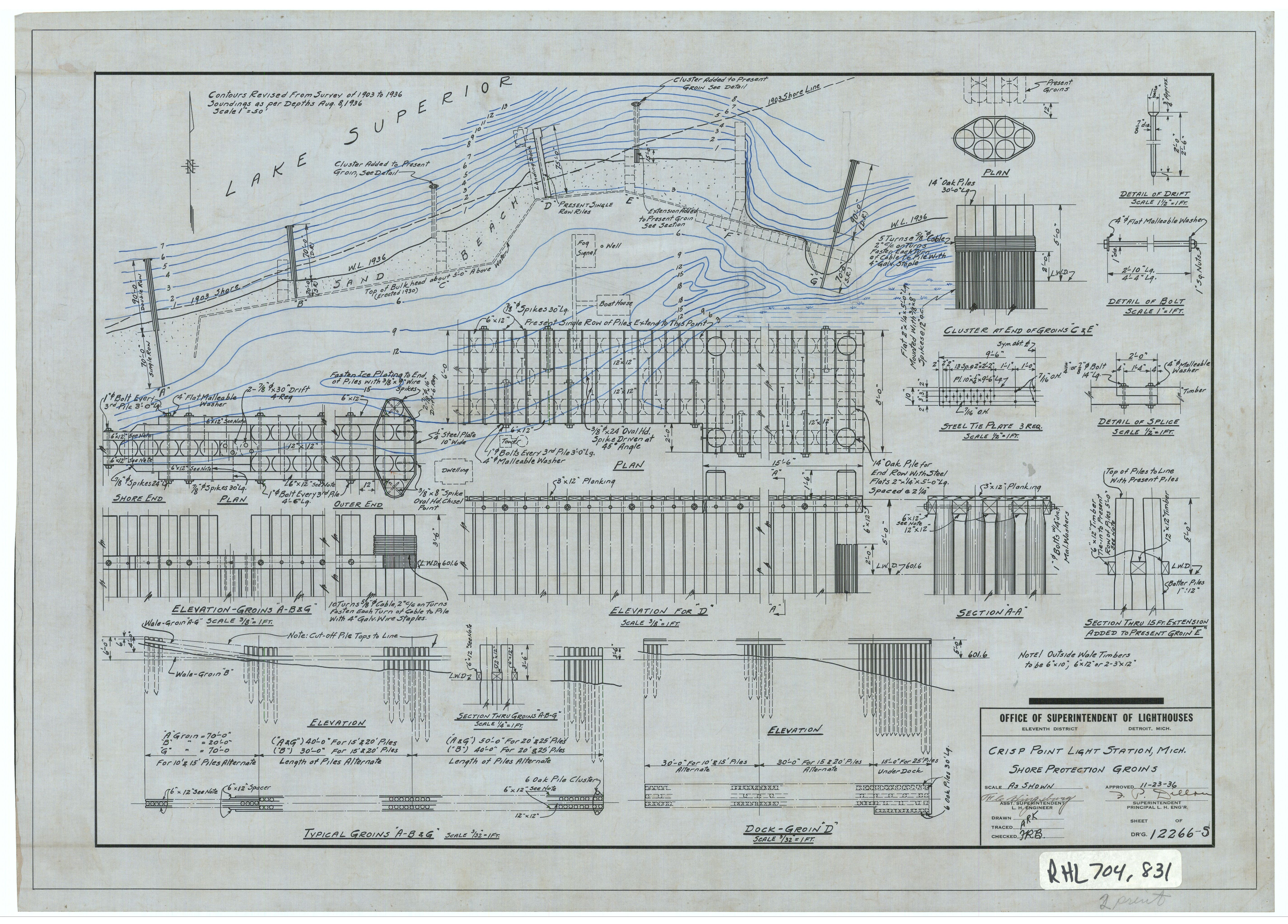
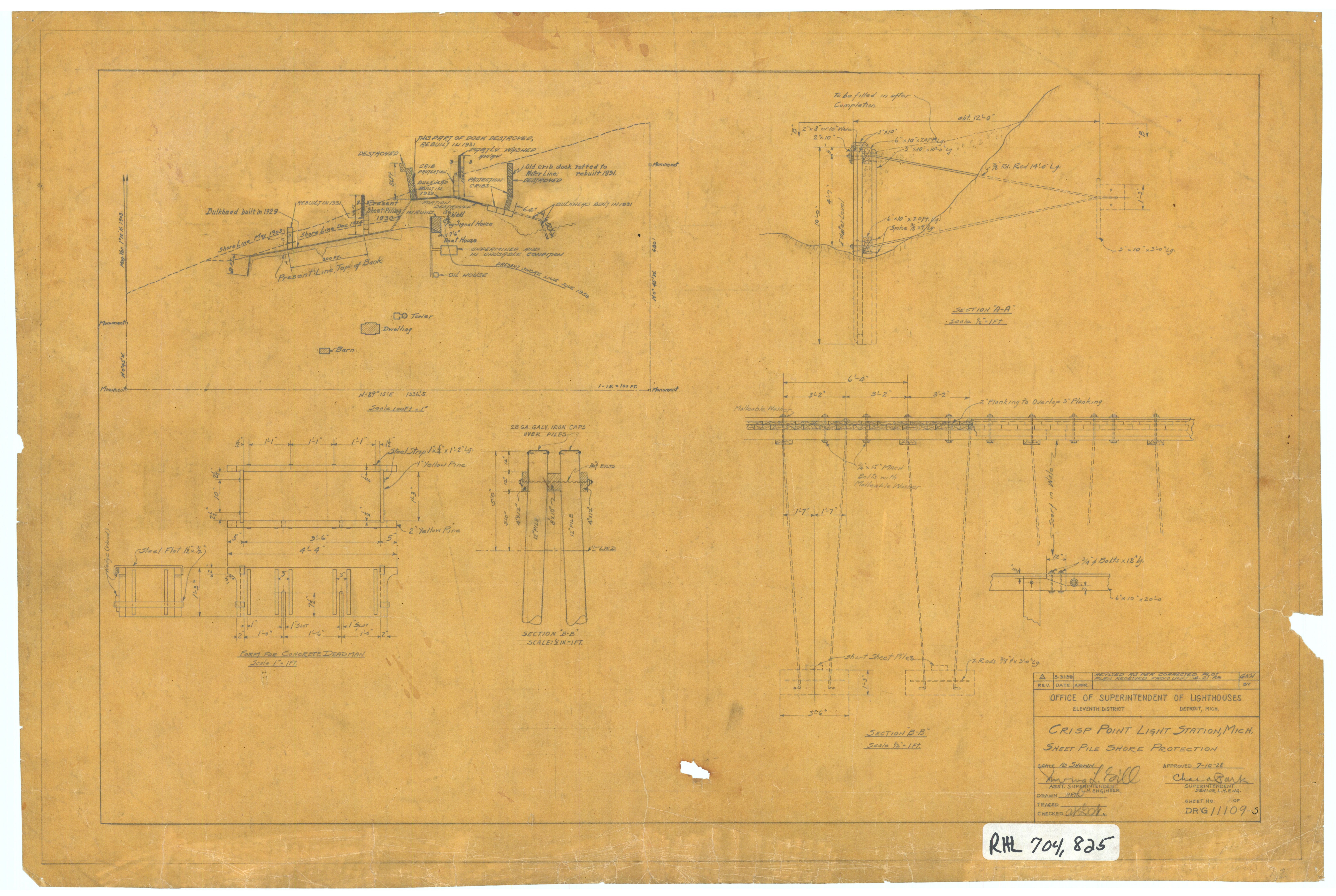
The fog signal building was a brick structure, 22' x 42', with a tin tile roof. A brick service room, built in 1906, was connected to the lighthouse tower. The landing crib was 12' wide by 132' long with a bulkhead 20' square. It was built on the west side of the boathouse, filled with stone, and decked. Groins were installed as part of the shoreline protection. Click here to see a 1936 drawing of the shoreline protection. Click here to see a 1959 drawing of the shoreline structures.
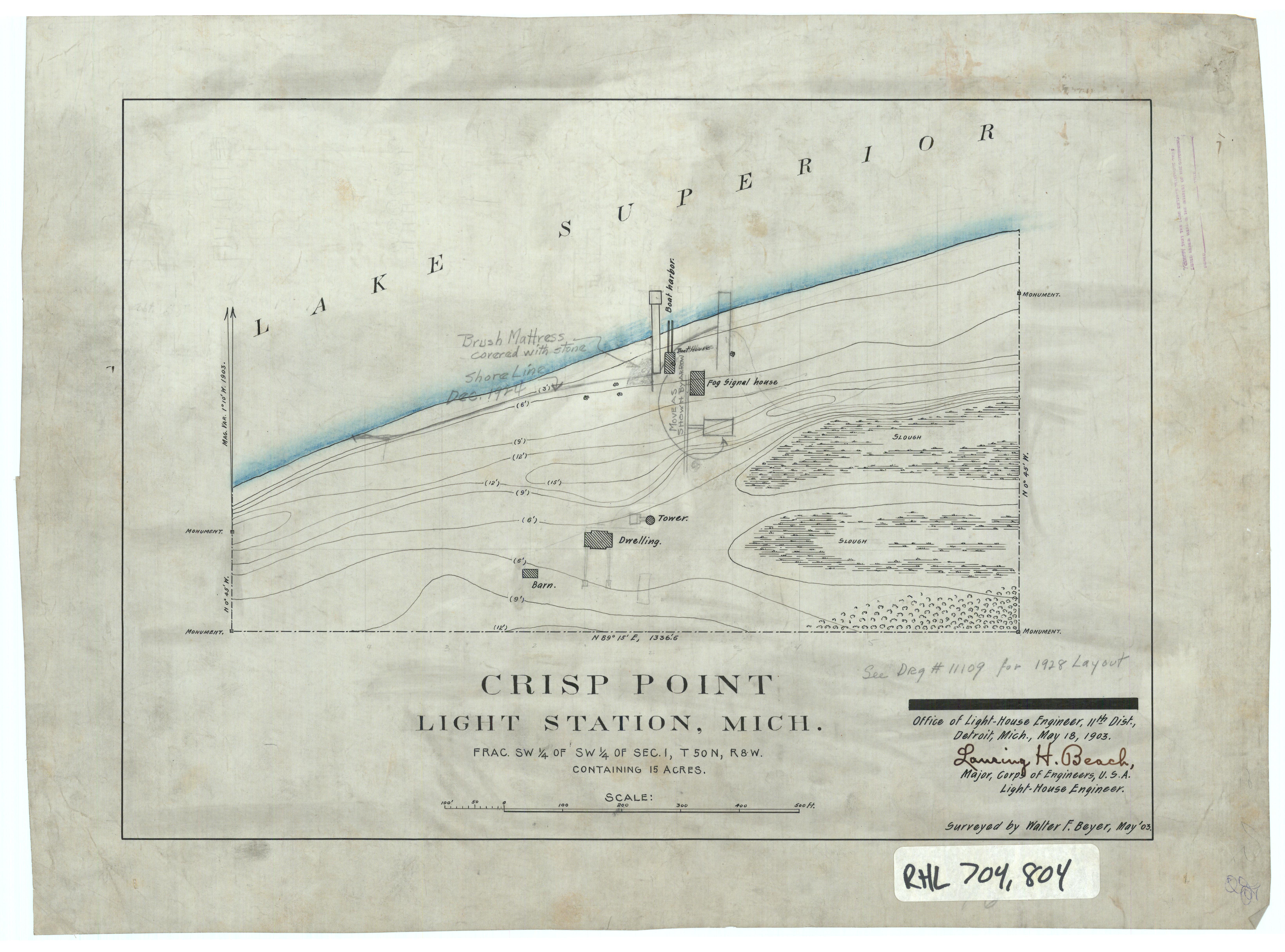
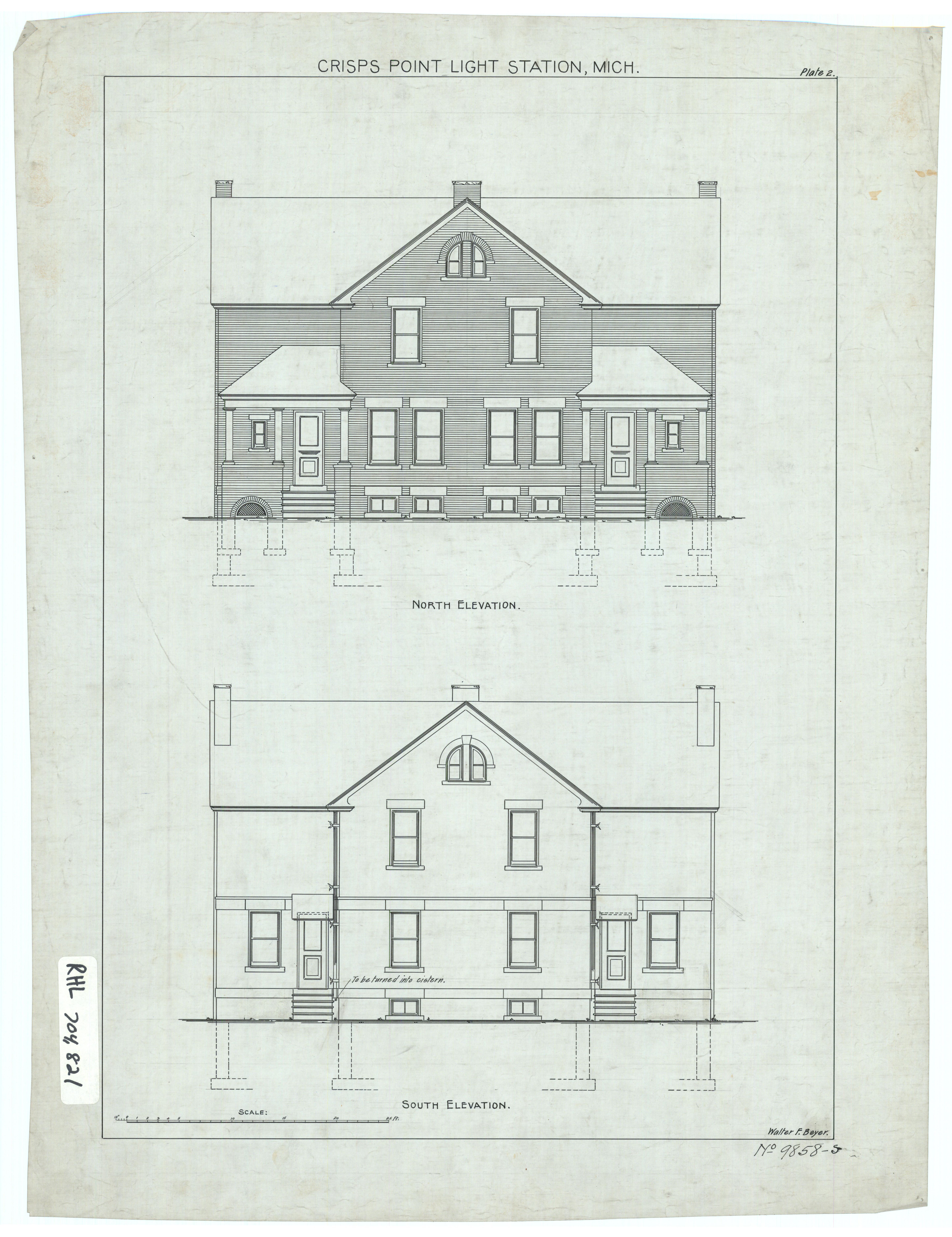
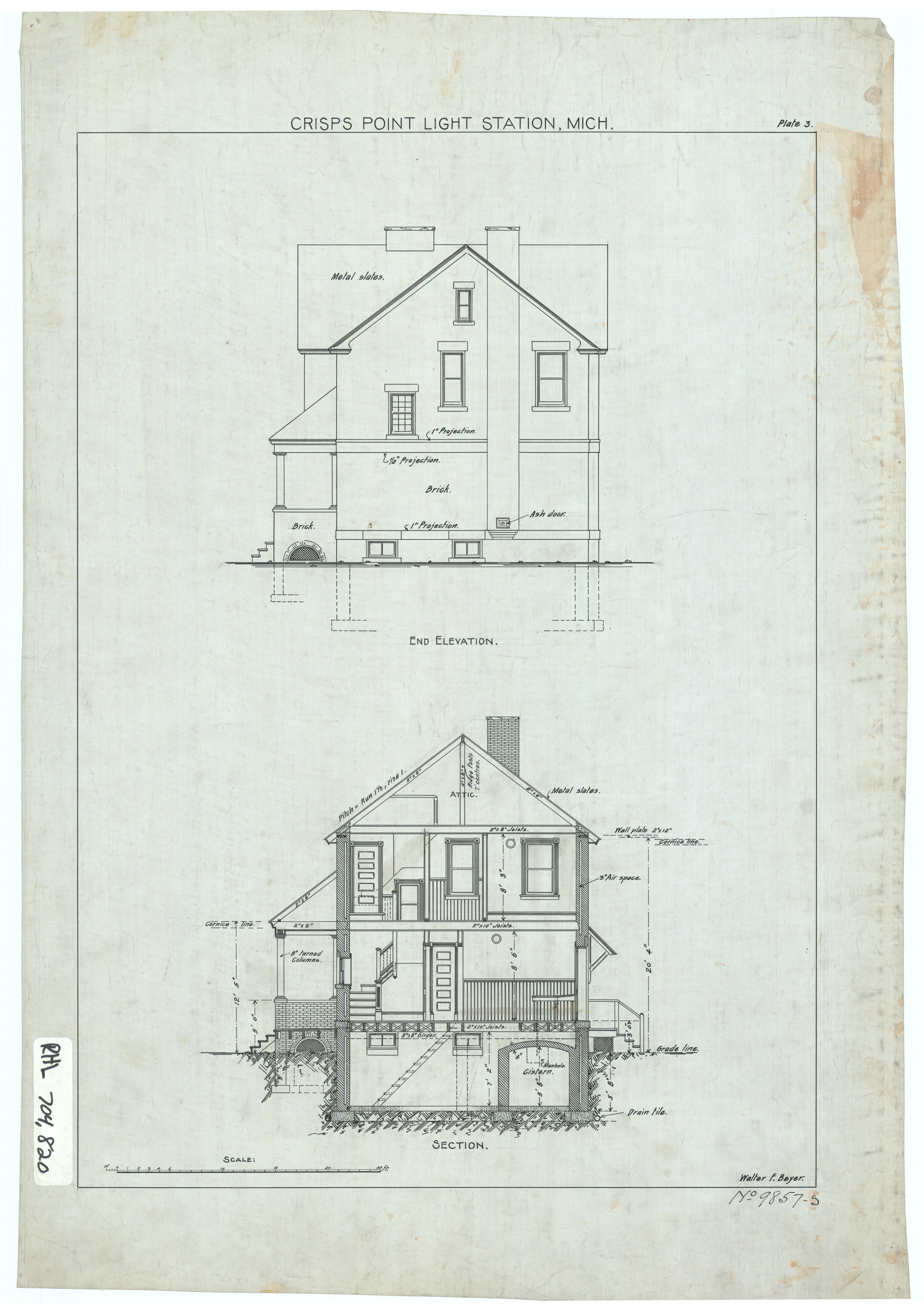
In all, there was a life-saving station and quarters, a two family brick light keepers' dwelling with basement, brick fog signal building, oilhouse, two frame barns, boathouse and landing, tramway, lighthouse tower and service room entrance. Click here to see a 1903 drawing of the complex by Major Beach of the US Corps of Engineers. Click here to see a front and back view drawing of the light keepers' dwelling. Click here to see side view drawings of the light keepers' dwelling.
The Crisp Point Light Historical Society is a non-profit, charitable organization that has been formed to ensure the continued existence of the lighthouse at Crisp Point, to restore and maintain it for the present and future as a historically significant lighthouse and life saving station of Upper Michigan and Lake Superior. The lighthouse is currently owned by Luce County and The Crisp Point Light Historical Society is leasing the light in 40 year increments. CPLHS is in charge of maintaining, operating, and restoring Crisp Point Light.

Roll Superior, cast thy strength; twisting, raging, turning.
But the Sailor knows no doubt or fear,
For through the night comes a glean of cheer - Crisp Point light is burning.
Rage Superior, spread thy fog, sleet, rain, and snowing.
But the Sailor sleeps in faith secure,
Though the stars are gone, the way is sure - Crisp Point horn is blowing.
Storm Superior, rage and roll. Spread thy vain endeavor.
Here no tale of death to tell - Crisp Point watch is ever.
| Record Group 26, Box 172, Dates: 5/27/1877-11/1882 |
|---|
|
| Record Group 26, Box 173, Dates: 5/8/1883-5/1/1886 |
| Record Group 26, Box 174, Dates: 5/2/1886-4/27/1889 |
| Record Group 26, Box 175, Dates: 4/28/1889-4/23/1892 |
| Record Group 26, Box 176, Dates: 4/24/1892-4/20/1895 |
| Record Group 26, Box 177, Dates: 4/21/1895-4/17/1898 |
| Record Group 26, Box 178, Dates: 4/18/1898-4/13/1901 |
| Record Group 26, Box 179, Dates: 4/14/1901-4/9/1904 |
| Record Group 26, Box 180, Dates: 4/10/1904-12/31/1906 |
| There are additional boxes going all the way to 1935. |
| Start | End | |||||||||||
|---|---|---|---|---|---|---|---|---|---|---|---|---|
| Position | Last Name | First Name | M.I. | Born | Died | Day | Month | Year | Day | Month | Year | Comment |
| 1st Assistant | Gramer | William | J. | Dec. 14, 1870 | April 16, 1955 | 1 | 3 | 1904 | 30 | 6 | 1907 | Transferred, promoted |
| Keeper | Smith | John | E. | 1872 | May 4, 1959 | 1 | 3 | 1904 | 31 | 8 | 1906 | Transferred |
| 2nd Assistant | Basel | Charles | H. | October 12, 1878 | April 21, 1968 | 27 | 4 | 1904 | 5 | 6 | 1904 | Resigned |
| 2nd Assistant | Robins | Lloyd | H. | February 26, 1872 | August 21, 1926 | 6 | 6 | 1904 | 31 | 8 | 1904 | Resigned |
| 2nd Assistant | Maguire | John | A. | 1865 Scotland | 1 | 4 | 1905 | 31 | 3 | 1907 | Resigned | |
| Keeper | Burrows | Herbert | N. | November 13, 1853 | March 25, 1938 | 1 | 9 | 1906 | 31 | 8 | 1910 | Transferred to Tawas Point |
| 2nd Assistant | Hawkins | Norman | Powell | February 14, 1883 | April 16, 1937 | 22 | 4 | 1907 | 31 | 7 | 1909 | Transferred to Detour |
| 1st Assistant | Campbell | Roger | W. | August 19, 1876 | May 27, 1961 | 12 | 7 | 1907 | 15 | 3 | 1912 | Transferred to Minnesota Point |
| 2nd Assistant | Massicotte | Samuel | June 10, 1866 | 29 | 9 | 1909 | 31 | 3 | 1911 | Transferred, promoted to Big Bay Point | ||
| Keeper | Smith | George | W. | 1871 | 1943 | 15 | 9 | 1910 | 28 | 2 | 1911 | Transferred to Round Island |
| Keeper | Gibb | Jacob | H. | March 6, 1852 | May 3, 1913 | 1 | 3 | 1911 | 22? | 4 | 1913 | Had to leave post due to illness. |
| 2nd Assistant | Hetu | Archie | September 25, 1884 | August 30, 1974 | 7 | 5 | 1911 | 1 | 4 | 1913 | Transferred to DeTour Reef Lighthouse. | |
| 1st Assistant | Haskell | Albert | E. | August 5, 1872 | May 18, 1948 | 15 | 3 | 1912 | 31 | 3 | 1917 | Transferred to Port Austin Reef. |
| 2nd Assistant | Taunt | Joseph | J. | March 21, 1888 | August 6, 1964 | 18 | 4 | 1913 | 31 | 3 | 1915 | Transferred to Au Sable Point. |
| Keeper | Coughlin | Peter | June 12, 1856 | October 5, 1934 | 25 | 5 | 1913 | 11 | 10 | 1913 | Transferred to Tawas Light Station | |
| Keeper | Hawkins | Norman | Powell | February 14, 1883 | April 16, 1937 | 20 | 10 | 1913 | 1 | 4 | 1917 | Transferred to Detour Point |
| 2nd Assistant | House | Harry | F. | September 23, 1894 | January 17, 1935 | 1 | 4 | 1915 | 16 | 11 | 1916 | Transferred to Devils Island. |
| 2nd Assistant | Hawkins | Walter | V. | 1897 | 1925 | 1916 | 20 | 12 | 1916 | Temporary Assignment | ||
| 2nd Assistant | Eby | Philip | F. | April 19, 1870 | May 16, 1919 | 16 | 2 | 1917 | 24 | 4 | 1917 | Promoted to 1st Assistant |
| 2nd Assistant | Hall | Edward | L. | 1917 | 31 | 3 | 1918 | Start date unsure. Resigned | ||||
| 1st Assistant | Towns | Edward | C. | September 17, 1879 | January 4, 1919 | 6 | 4 | 1917 | 14 | 4 | 1917 | Resigned |
| 1st Assistant | Eby | Philip | F. | April 19, 1870 | May 16, 1919 | 25 | 4 | 1917 | 6 | 4 | 1919 | Diagnosed w/ tuberculosis Jan. 2019 |
| Keeper | Crittenden | Herbert | Peck | February 27, 1872 | February 6, 1947 | 14 | 4 | 1917 | 21 | 6 | 1922 | Transferred to Grand Marais |
| 2nd Assistant | House | Harry | F. | September 23, 1894 | January 17, 1935 | 1 | 5 | 1918 | 1 | 4 | 1919 | Transferred to Outer Island |
| 2nd Assistant | Somes | Robert | G. | October 1, 1891 | July 26, 1928 | 6 | 4 | 1919 | 1 | 11 | 1920 | Dismissed for falling asleep on watch. |
| 1st Assistant | Clarke | Lewis | N. | July 18, 1899 | 1995 | 16 | 4 | 1919 | 8 | 12 | 1920 | Dismissed for sleeping on watch |
| 2nd Assistant | Hawkins | Charles | Herman | September 25, 1894 | December 21, 1972 | 1 | 3 | 1921 | 31 | 5 | 1921 | Resigned |
| 1st Assistant | Haven | Charles | H. | July 17, 1872 | September 9, 1948 | 1 | 4 | 1921 | 31 | 5 | 1921 | Resigned |
| 1st Assistant | McGregor | Edward | T. | April 9, 1888 | November 3, 1971 | 1 | 6 | 1921 | 14 | 6 | 1925 | Transferred to Manitou Island. |
| 2nd Assistant | Brown | Albert | Francis | February 2, 1896 | May 19, 1966 | 18 | 6 | 1921 | 9 | 4 | 1924 | Transferred to Ft. Gratiot |
| Keeper | Clark | Lawrence | William | August 18, 1873 | 1953 | 21 | 6 | 1922 | 31 | 5 | 1923 | Resigned |
| Keeper | Singleton | Joseph | Noah | October 14, 1879 | September 8, 1964 | 15 | 7 | 1923 | 31 | 12 | 1939 | Retired |
| 2nd Assistant | Dodd | Hazen | A. | August 14, 1896 | March 1, 1941 | 11 | 5 | 1924 | 1 | 4 | 1925 | Transferred to Fort Gratiot. |
| 2nd Assistant | Mead | Joseph | September 14, 1869 | July 4, 1958 | 8 | 4 | 1925 | 14 | 3 | 1927 | Transferred to Thunder Bay. (Swapped stations with Hawkins.) | |
| 1st Assistant | Schinderette | George | M. | September 7, 1869 | February 7, 1962 | 1 | 7 | 1925 | 10 | 10 | 1929 | Transferred to Point aux Barques |
| 2nd Assistant | Hawkins | Charles | Herman | September 25, 1894 | December 21, 1972 | 14 | 3 | 1927 | 12 | 8 | 1929 | Transferred to Whitefish Point. |
| 2nd Assistant | Sowry | Harry | L. | February 18, 1903 | 9 | 9 | 1929 | 30 | 9 | 1929 | Promoted temporarily. | |
| 1st Assistant | Sowry | Harry | L. | February 18, 1903 | 1 | 10 | 1929 | 14 | 3 | 1930 | Went back to 2nd Assistant, transferred to Huron Island. | |
| 2nd Assistant | Nitz | Gustav | T.A. | February 17, 1880 | December 7, 1967 | 10? | 1929 | 12 | 12 | 1929 | Start date unsure | |
| 2nd Assistant | Sowry | Harry | L. | February 18, 1903 | 15 | 3 | 1930 | 25 | 9 | 1930 | Transferred | |
| 2nd Assistant | Winfield | Herbert | J. | May 25, 1879 | May 25, 1940 | 9 | 10 | 1930 | 31 | 1 | 1940 | Promoted to 1st Assistant |
| 1st Assistant | Brown | Albert | Francis | February 2, 1896 | May 19, 1966 | 16 | 4 | 1930 | 1 | 2 | 1940 | Promoted to Keeper |
| 1st Assistant | Winfield | Herbert | J. | May 25, 1879 | May 25, 1940 | 1 | 2 | 1940 | 16 | 5 | 1940 | Approved for disability retirement to take effect 4/30/1940. |
| 1st Assistant | Babbitt | Frank | P. | 1940 | 1940 | |||||||
| Keeper | Brown | Albert | Francis | February 2, 1896 | May 19, 1966 | 1 | 2 | 1940 | 30 | 9 | 1940 | Retired due to disability |